 한국어
 English
 简体中文
 繁體中文
 日本語
 Монгол
 Русский
 ไทย
 Indonesia
 Tiếng Việt
 العربية


A failed nose surgery,
reborn
Complex Revision Rhinoplasty
Advanced Revision Rhinoplasty
What Is Revision Rhinoplasty at SH Plastic Surgery?
SH Plastic Surgery
It is surgery to resolve complications after nose surgery, such as a drooping tip, an upturned tip or a nose that is too high.
- Damaged tissue
- Weakened support structure
- Scar tissue
- Effects of previous implants
An accurate structure must be redesigned within an environment that is already deformed.
This requires far greater anatomical understanding and more precise surgical experience than a first surgery.
The goal of revision rhinoplasty is not "a nose that looks pretty now," butDr. Seonghun Kim, SH Chief Director
a nose that does not collapse even after a long time.
Before & After
Correcting the cause:
structural redesign
Before & After
Function and aesthetic balance,
restored at the same time
SH, Different
SH, Different 01
-
 1
Precise analysis of even hidden problems
Precise structural diagnosisWe analyze the cause of the previous surgery's failure based on the internal structure of the nose, not its outward appearance.
SH, Different 02
-
 2
Process-focused explanations that reduce anxiety
In-depth 1:1 personalized consultationThe operating surgeon personally explains and plans every step, from consultation to design, surgery and recovery care.
SH, Different 03
-
 3
The key step to avoid another failure
Customized design based on the cause of failureEvery revision has a different cause. SH designs around the cause, not the type.
SH, Different 04
-
 4
Structural correction down to the details
Improving function, structure and aesthetics togetherThe tip, cartilage, soft tissue and support structure are corrected into a structure that lasts over time.
SH's Approach to Facial Structure
Leonardo da Vinci's
structural analysis
SH's revision rhinoplasty
To draw a beautiful face, Leonardo da Vinci
did not simply trace its outline.
He divided the face by reference points and analyzed the role of each position.
interprets the nose not as a single line, but as a set of structures and transition points.
Types of Revision Rhinoplasty
-
 01
Drooping tip
Corrected when tip support is insufficient or there is an implant problem.
-
 02
Dissatisfaction with the nose line
Corrected when the bridge or alar line is unsatisfactory.
-
 03
Deviated nose
Corrected when the nasal bone is deviated or the implant has shifted.
-
 04
Bulbous nose not improved
Corrected when a bulbous nose has not improved after correction.
-
 05
Hump still present
Corrected when a hump still remains.
-
 06
Inflammation
When inflammation occurs in people with thin skin, the implant is removed or replaced.
-
 07
Moving implant
Corrected when the implant has not settled properly.
-
 08
Visible implant
Corrected when the implant has descended into the tip or the skin has thinned so that it shows through.
-
 09
Contracted nose due to complications
Corrects a nose contracted by complications such as capsular contracture.
Your own tissue that does not change over time: autologous tissue
For safe and natural results, SH Plastic Surgery favors structural reconstruction
based on autologous tissue, which has the highest biocompatibility.
SH selects the most suitable autologous tissue for each patient's tissue condition and performs customized structural reconstruction.
- Autologous dermis & fascia Buttock dermis, post-auricular fascia, scalp fascia
- Autologous cartilage Septal cartilage, ear cartilage, rib cartilage
-
1
Autologous dermis & fascia
-
2
Autologous cartilage

SH Autologous Dermis Graft Procedure
Autologous dermis uses tissue from the dermal layer beneath the skin.
With a low absorption rate and high stability, it is effective for maintaining shape in the long term.
-
 Step 01
1. Buttock dermis harvest
Autologous dermis is harvested from the buttock area.
-
 Step 02
2. Bridge dermis graft
A dermis graft naturally refines the bridge line.
-
 Step 03
3. Tip dermis graft
Adds natural volume and height to the tip.
SH Autologous Fascia Graft Procedure
Autologous fascia uses a thin, strong fibrous membrane that surrounds muscle.
It acts as a cushion between the skin and implant and is effective for creating natural, soft lines.
-
 Step 01
1. Post-auricular or scalp fascia harvest
Autologous fascia is harvested from behind the ear or from the scalp.
-
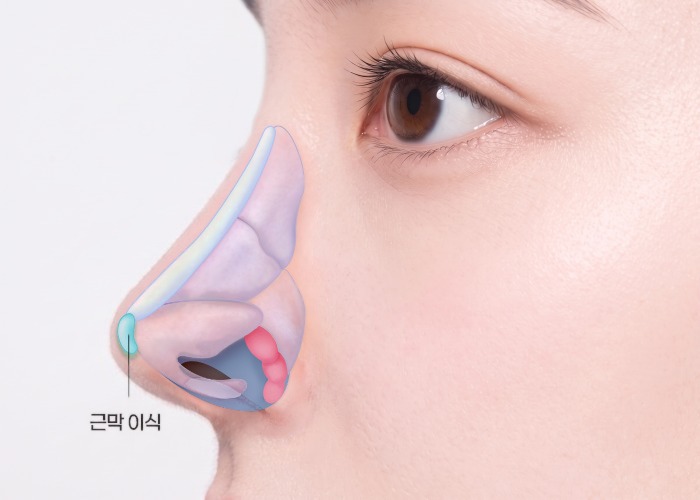 Step 02
2. Bridge fascia graft
Naturally refines the bridge line and creates a soft contour.
-
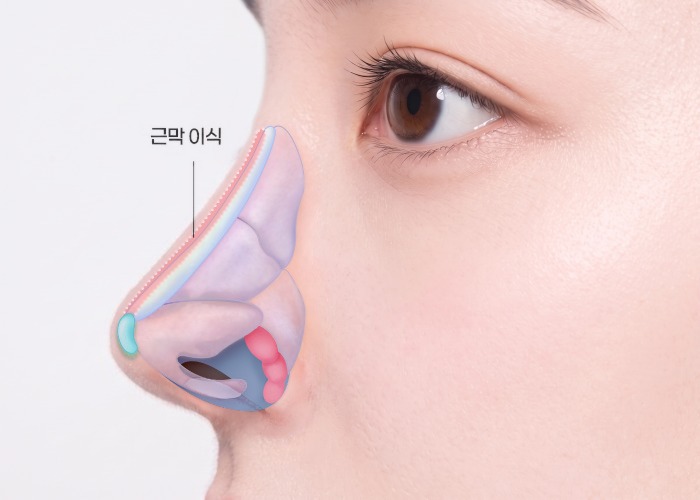 Step 03
3. Protective layer over the implant
It covers the implant to reduce show-through and gives a natural feel and shape.
SH Autologous Cartilage Procedure
With precise cartilage design tailored to each patient's condition, SH achieves both structural stability and natural results.
-
 Step 01
1. Rib cartilage harvest
Rib cartilage harvest: the required amount of rib cartilage is harvested from below the chest.
(A small scar of about 2~3cm may result) -
 Step 02
2. Cartilage carving
The harvested cartilage is precisely carved for use as struts and for reinforcing the tip structure.
-
 Step 03
3. Structural reconstruction and fixation
The collapsed structure is rebuilt to secure tip support and stability.
-
 Step 04
4. Final line
A nose collapsed by contracture or deformity is finished with a natural, stable line.
SH Plastic Surgery's Surgical Principles
Plastic surgery is not simply a technique for changing appearance;
it is medicine that understands the structure and balance of the face.
For natural and stable results, SH Plastic Surgery performs surgery
based on the following principles.
We analyze structure first

The eyes, nose and face are not independent structures; they influence each other to form your impression.
SH Plastic Surgery does not look only at the shape of the eyes or nose; we analyze
- Eyeball position
- Brow bone structure
- Facial skeleton
- Tissue balance
to understand the facial structure first.
We value balance over excessive change

The goal of plastic surgery is not to change the face excessively
but to improve its overall balance.
SH Plastic Surgery considers facial proportions and harmony
to pursue natural and stable change.
Surgery begins with design

Good results are not suddenly created in the operating room.
We create a design suited to your facial structure through accurate analysis, and the surgery is performed based on that design.
SH Plastic Surgery performs design-based surgery grounded in structural analysis.
We consider long-term stability

Results should look natural not only right after surgery but also as time passes.
SH Plastic Surgery chooses the surgical method
with tissue stability and long-term change in mind.
Patient safety comes first

The most important thing in plastic surgery is patient safety.
- A dedicated, accountable medical team
- Surgeon name disclosure in the operating room
- Systematic management of the surgical environment
These measures keep the surgical environment safe.


SH PHILOSOPHY
Natural beauty
begins with structure and balance
SH Plastic Surgery designs change based on an understanding of facial structure,
not a simple change in appearance.
The change that suits each patient most naturally:
that is SH Plastic Surgery's standard for plastic surgery

SH Precision Diagnosis System
Diagnosis that analyzes even hidden causes makes the difference in results.
Before surgery, SH Plastic Surgery goes beyond a simple assessment of appearance, using a precise diagnosis that considers function · structure · internal condition
to reduce unnecessary surgery and lower the likelihood of revision.
Before surgery, endoscopy accurately diagnoses rhinitis, congenital nasal cavity deformities, sinusitis, nasal valve problems and other
internal structures that cannot be seen with the naked eye
Functional problems are identified in advance to plan surgery that considers both aesthetics and function
Accurate diagnosis is what makes results last.
SH Post-Operative Care System
SH Plastic Surgery systematically manages swelling, pain, scarring and the other recovery concerns
patients worry about most, with a 1:1 personalized care system.
 System 01
Swelling injection treatment
Injections that help relieve swelling and bruising for faster recovery of the surgical area
Care that speeds recovery and brings your return to daily life sooner System 02
Swelling laser care
Laser care effective for relieving swelling, for faster recovery of the surgical area
Helps tissue stabilization and recovery System 03
Scar injection treatment
If a scar hardens or becomes raised, scar injections tailored to your condition soften and improve it
Early scar management to maintain a natural result System 04
Recovery management system
Warming blankets & instant warm-air units verified for safety to international standards
Help maintain body temperature and blood circulation after surgery for a more stable recovery System 05
LDM ultrasound care
Uses ultrasound energy to support skin tissue recovery
and helps tissue stabilization and swelling relief. System 06
Radiofrequency care
Uses radiofrequency energy to improve blood circulation
and support tissue recovery and skin condition.
SH Youtube
-

Considering facial harmony: Redesign Revision Rhinoplasty
Redesigning a natural nose line in harmony with the face
-

Analyzing the cause of failure: Complex Revision Rhinoplasty
Precise revision that analyzes complex causes for a more complete result
-

Greater stability: Autologous Rib Cartilage Revision Rhinoplasty
Improving nasal structure with strong support for greater stability
-

Supporting tissue regeneration: Stem Cell Revision Rhinoplasty
Delicate revision care that considers the recovery process
-

Analyzing the causes of deformity and adhesion: Nasal Implant Removal
Precise removal surgery that considers changes in nasal structure and tissue adhesion
-

Tracing the cause of complications: Foreign Material/Filler Removal
Removal surgery based on cause analysis to prevent recurring problems
-

Worried about revision rhinoplasty: can it work for me? A self-check for nose surgery complications…
-

When can you have revision rhinoplasty? Let's also look at alar reduction for the finishing touch!
-

A must-watch Q&A video before rhinoplasty! Answers about revision rhinoplasty too!
-

Rhinoplasty, eye surgery, men's plastic surgery: REAL before-and-after reviews of men's surgery. Don't miss…
-

Rhinoplasty that doesn't fail! Getting it right the first time is best!
-

Short nose, long nose, hooked nose: who needs rhinoplasty?
-

Looking for a rhinoplasty clinic you'll be happy with? Check rhinoplasty before-and-afters here…
-

Take a moment to see these rhinoplasty reviews
-

The principles of honest plastic surgery: this is SH Plastic Surgery
-

"The secret to looking young is here" This video reveals the secret!
-

What is 'this procedure' that a plastic surgeon strongly recommended to his parents?
-

This is when Renuvion's effects appear! (For fast recovery, SH uses 'this'…